Materiali e struttura
The rules we hold ourselves to when we describe a garment. They are stricter than the law requires in three places, and this page says exactly where and why.
Last updated
15 August 2026
Governing law
Italian law. The exclusive forum is the court of the consumer’s place of residence or domicile.
Why this page exists
Outerwear is the only clothing category where most of what you are paying for is invisible once the garment is finished. A jacket with a bonded front and a jacket with a floating canvas can be cut from the same cloth, look identical on a rail, and differ by three hundred dollars. The trade knows this. Very little of the trade publishes it.
These are the rules we apply to every product page. A garment that cannot satisfy them does not go on sale — that is enforced by a check that runs when the site is built, not by someone remembering.
Rule 1 — The interlining is always named
Every tailored jacket and every overcoat states which of four constructions its front panel uses. There is no fifth option and no way to leave the field blank.
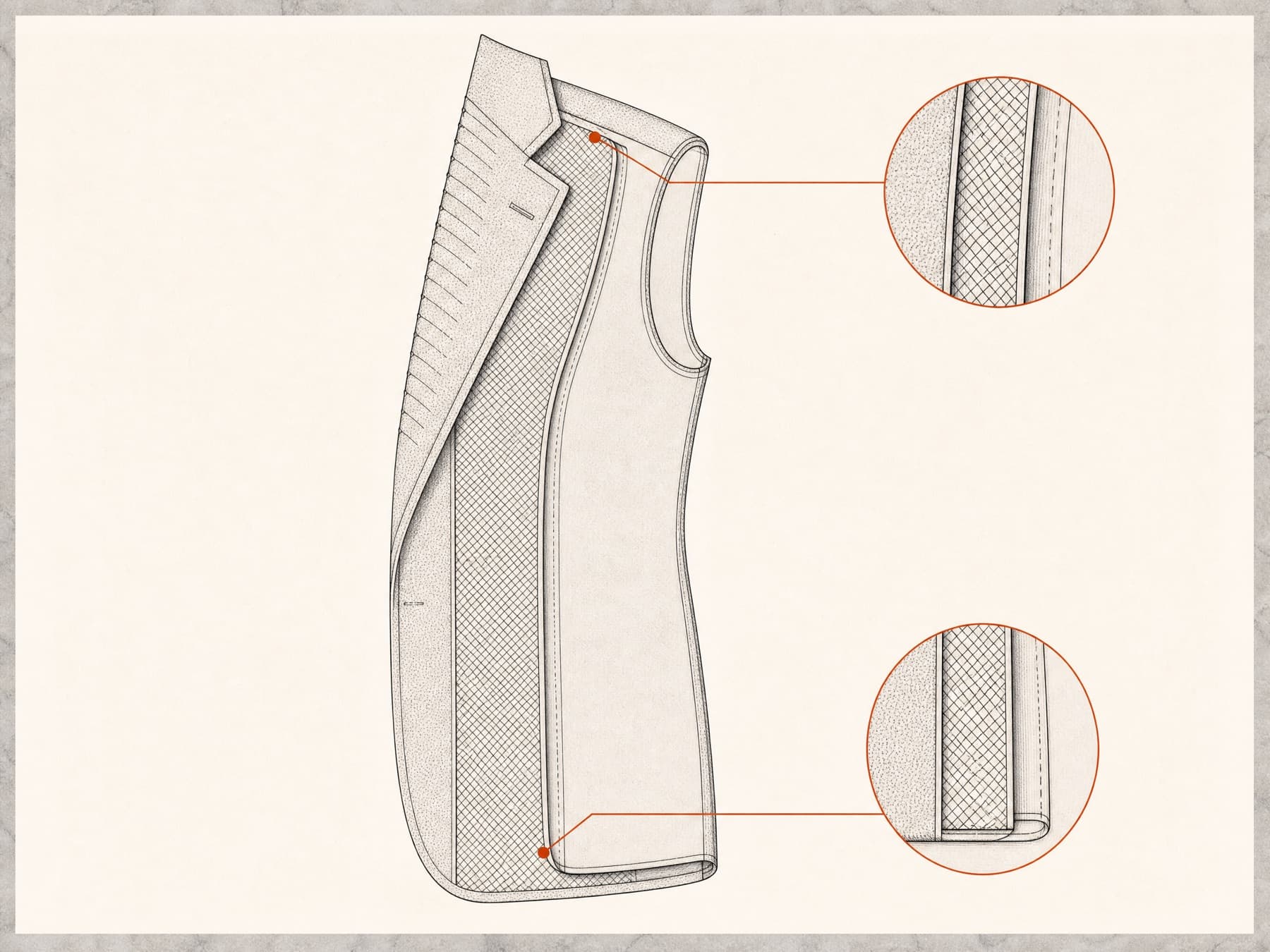
Full canvas
A floating horsehair canvas runs the whole length of the front panel and is pad-stitched through the lapel roll. No adhesive anywhere in the front construction.
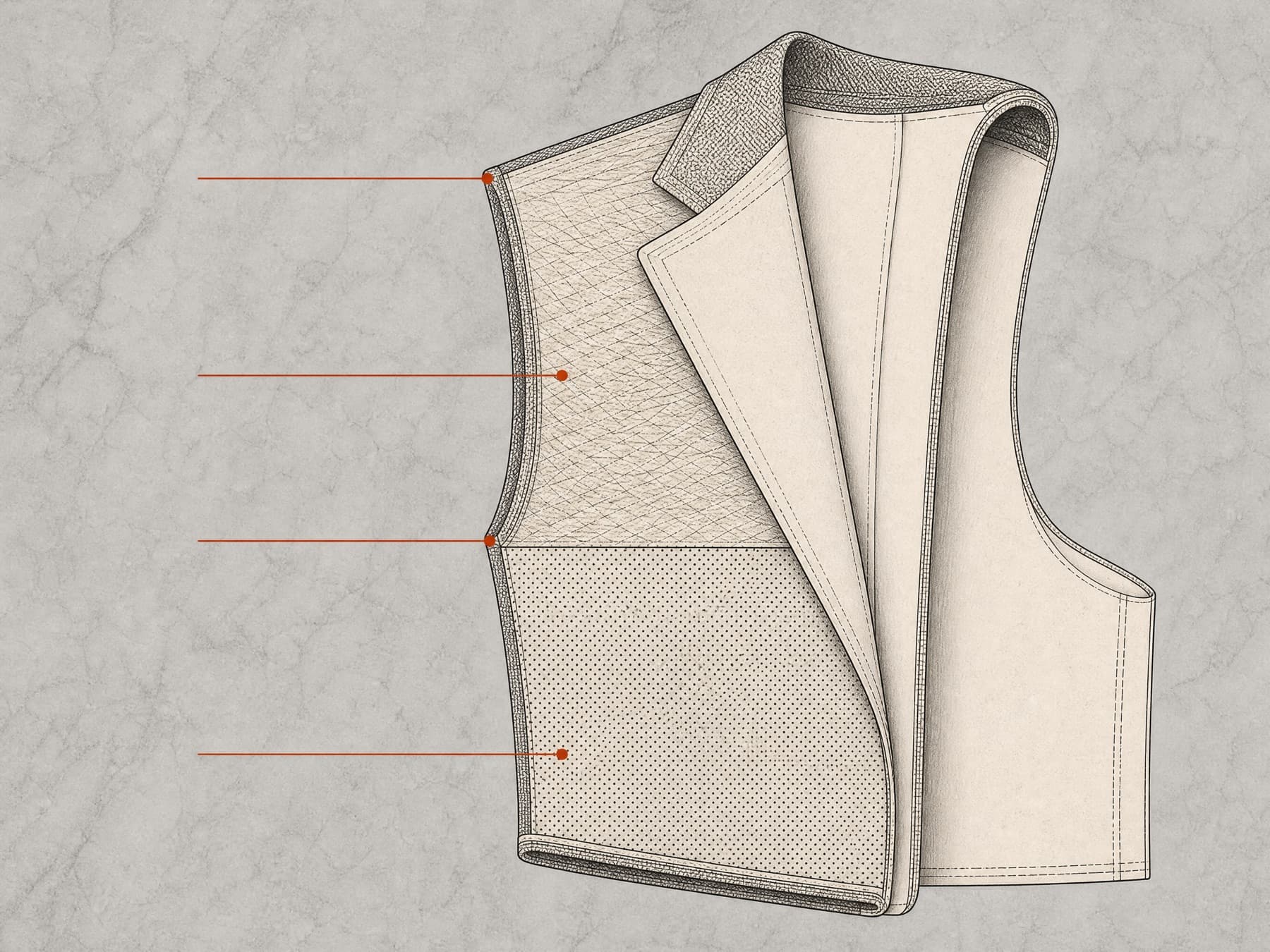
Half canvas
Floating canvas over the chest and lapel; bonded interfacing from the transition point down. We state where the transition falls.
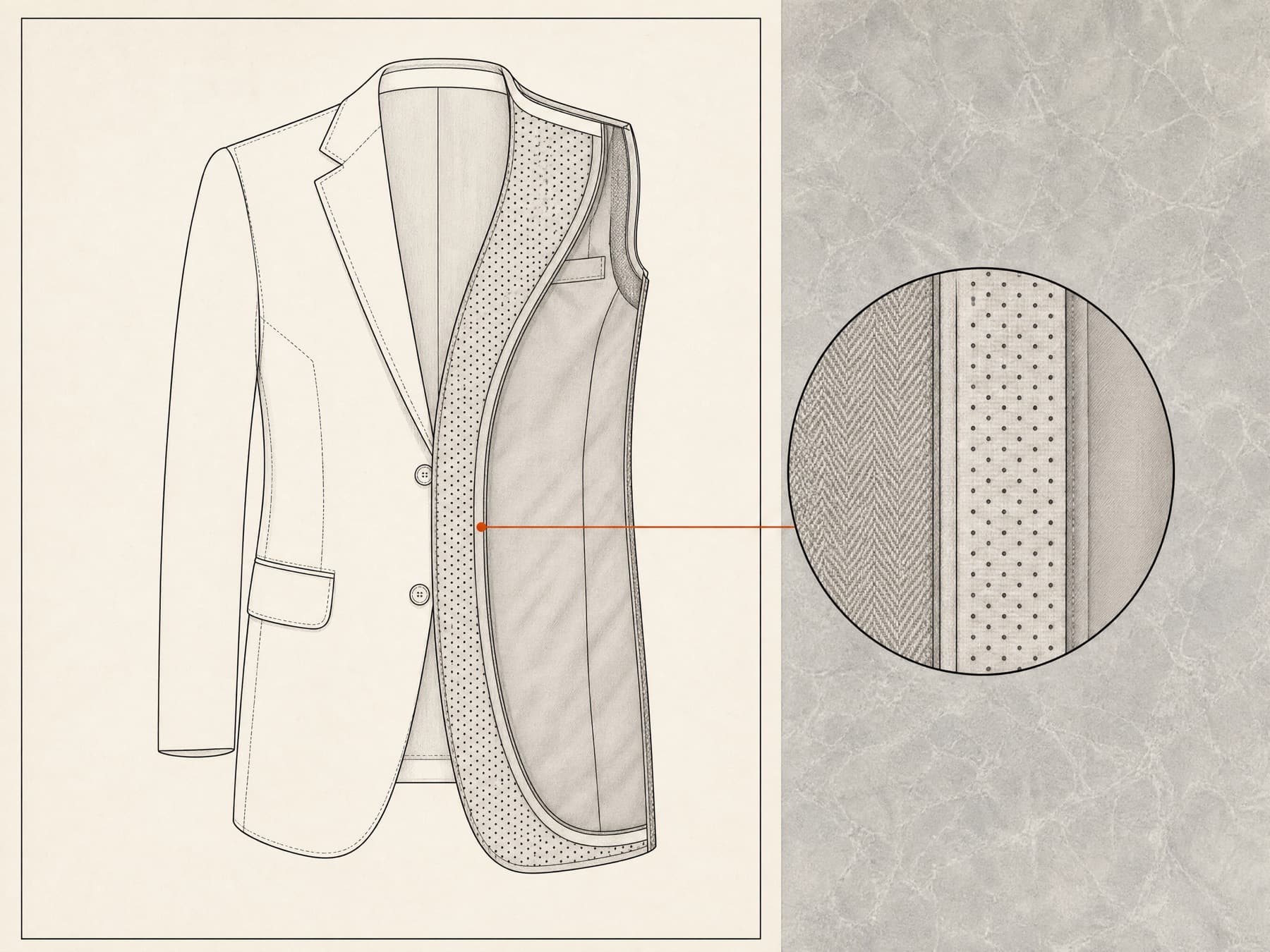
Fusible
Interfacing bonded to the back of the cloth across the entire panel. Cheapest to make, flattest on day one, and the one that can delaminate.
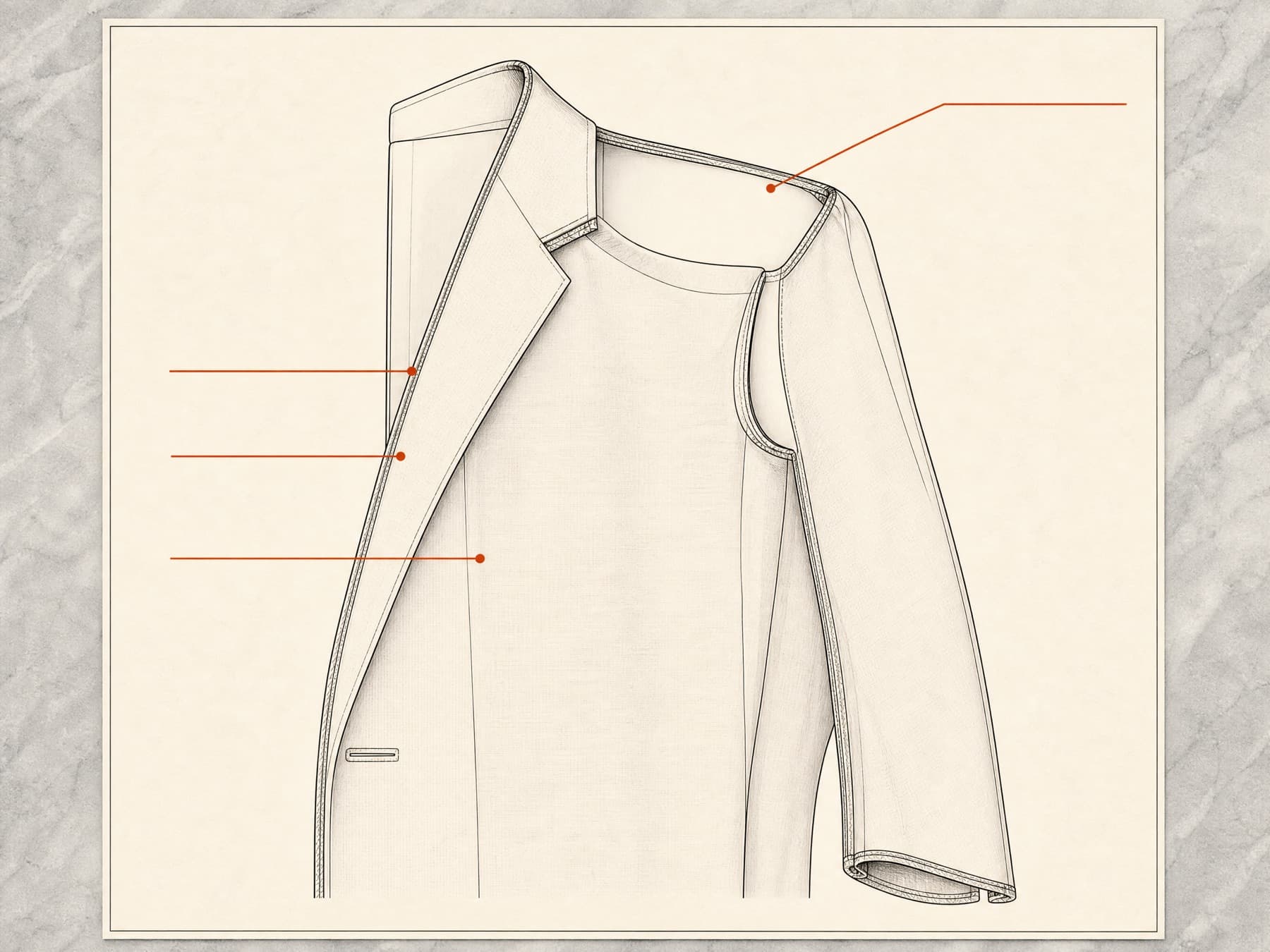
Unstructured
No interlining and no shoulder pad. A light gauze at most. The garment follows the body instead of shaping it.
We never omit “fusible”. Leaving the field out is the standard way the trade hides it, and phrases like “expertly constructed” exist precisely to fill that gap. We do not use them.
We also never describe a garment as full canvas unless the canvas genuinely runs the full length, and we do not use craft grades we have not earned. Nothing on this site is described as hand work unless it is.
Rule 2 — Insulation carries four figures, or an explicit not-applicable
Every insulated garment publishes all four of these. One missing and it does not list.
- Ratio of down to feather, as a percentage. Never the word “down” on its own. Down clusters trap air; feathers have quills and mostly add weight. A 90/10 fill and a 70/30 fill are different products.
- Fill power, with the test standard beside it. A number without a standard is not a measurement. Ours are measured to IDFB Part 10-B, steam conditioned, in cubic inches per ounce. Where no loft test has been run, the row says so and no number is shown.
- Fill weight in grams, for the reference size, as actually filled.
- The source animal, named by species — goose or duck, not “bird”.
Fill power is warmth per gram, not warmth
Our 850 fill power jacket holds 190 g of down. Our 750 fill power coat holds 340 g and is considerably warmer — and costs less. High fill power buys the same warmth at lower weight and smaller packed size. If neither matters to you, it is the wrong thing to pay for. We say this on the product pages of the expensive pieces, where it costs us money to say it.
Animal welfare. We hold no welfare certification for the down we buy, so we make no welfare claim. Uncertified welfare language is worth nothing to you. If we ever obtain certification we will name the scheme and publish the certificate number, and until then this paragraph stays as it is.
Synthetic fills carry the fill type and the fill weight, and the down-specific rows read as not applicable rather than being quietly removed — so you can tell the difference between a figure that does not apply and a figure we did not print.
Rule 3 — Animal-derived parts are declared
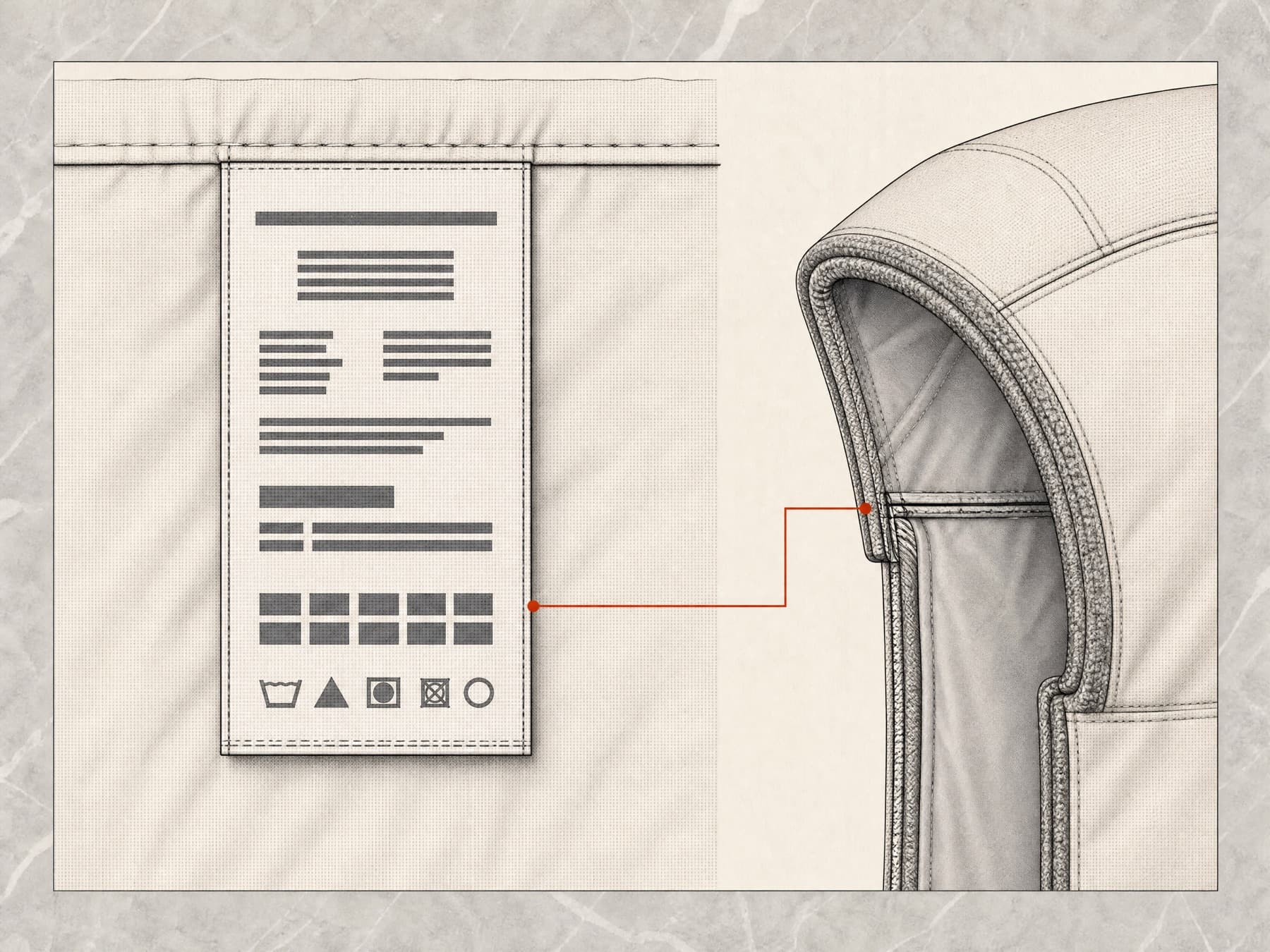
Under EU Regulation 1007/2011, a textile product containing non-textile parts of animal origin must carry the declaration “Contiene parti non tessili di origine animale”. It appears on the sewn-in label and it also appears on the product page, so you know before you buy rather than after.
- Where a garment contains real fur we name the animal species and state plainly that it is real. No garment currently sold on this site uses fur of any kind. Should that ever change, the disclosure would be complete and legally sourced or the piece would not list.
- Where a trim imitates fur we write faux fur and name the synthetic material it is made from.
- Leather and suede name the species and the tannage. Our one suede piece is goat, chrome tanned.
- Down and feather count as animal-derived and carry the same declaration alongside the four fill figures.
Some destinations restrict the import of animal-derived textiles. Where a permit is required and you do not hold one, we cancel and refund in full rather than send a parcel that will be seized — see shipping restrictions.
Rule 4 — No rain claim without a published test
Two garments on this site carry a repellency rating. Both publish the rating and the exact laboratory conditions it was measured under, including what happened after ten wash cycles, and both state that the seams are stitched rather than taped and therefore sit outside the scope of the rating.
Every other coat here says nothing at all about rain, because we have run no test on them. A densely woven gabardine sheds a light shower through weave density alone; that is not a performance claim and we do not dress it up as one. We use no absolute rain, wind or moisture-transport language anywhere on this site.
Rule 5 — Both origins, on every piece
Every product page names where the fabric was woven and where the garment was sewn. They are frequently different countries, and a single origin line would hide that.
We make no country-of-origin marketing claim of any kind — no origin badge, no flag, no map, no place name used as a collection name. The two factual lines are what we publish, and the sewn-in label on the garment you receive is definitive. Origins reflect the current production batch and change with it.
Rule 6 — Struck-through prices must be real
A former price shown beside a selling price must be the lowest price actually applied to that item in the previous thirty days, under directive 98/6/EC as amended. Where that test cannot be met, no former price is shown. At the date of this page, nothing in the shop carries a struck-through price.
Set prices are compared against the sum of the members’ current individual prices. That is a statement about today, not a former-price claim.
What happens when a rule cannot be met
The rules above are checked automatically every time this site is built. A garment missing an interlining type, missing any of the four fill figures, carrying an incomplete animal-origin declaration, showing a rain claim without test conditions, missing either origin line, missing its layering allowance, or carrying a former price that fails the thirty-day test will stop the build. It cannot reach the shop.
If you find something on this site that breaks one of these rules, we would genuinely like to know: support@leclothing.shop.
Questions about this page
Contatti: support@leclothing.shop · +39 334 591 2638
L & E S.R.L., Via della Moscova 49, 20121 Milano (MI), Italia. Monday to Friday, 09:00 to 18:00 CET.
Legal notice
Note legali
Who is selling to you: registered name, registered office and registration data.
Terms and conditions of sale
Condizioni di vendita
How a contract is formed, what you pay, how promotions work, how payment is secured, and what we do not sell.
Right of withdrawal and cancellation
Diritto di recesso
Fourteen days to withdraw without giving a reason, the statutory withdrawal form, and how a cancellation is handled.
Shipping, delivery and returns
Spedizioni e resi
Destinations, carriers, timescales, rates, duties, and the step-by-step return process.
Refund and dispute policy
Rimborsi
When a refund is due, how much of it, how long it takes, and how to dispute an outcome.
Statutory guarantee of conformity
Garanzia legale
Two years of conformity cover, what counts as a defect, and what counts as wear.
Privacy notice
Privacy
What we collect, why, for how long, who sees it, and how to exercise your rights.
Cookie notice
Cookie
Every cookie we set, what it does, how long it lasts, and how to withdraw consent.
Contact
Contatti
Email, telephone, registered address and a written enquiry form.